




Deposit Return Systems: How Returning Packaging Supports a Circular Economy
Table of Contents
Every year, billions of beverage containers are consumed around the world. While many are recyclable, a significant number still end up in landfills, rivers, forests, and oceans, contributing to pollution and the unnecessary loss of valuable materials.
Deposit Return Systems (DRS) are designed to address this challenge by encouraging consumers to return empty beverage containers for recycling or reuse. By assigning a refundable deposit to eligible packaging, these systems help keep valuable materials in circulation, reduce waste, and support the transition toward a circular economy.
As more countries adopt deposit return programs, they are becoming an increasingly important part of national waste management and sustainability strategies. Türkiye has also introduced its own Deposit Return System, known as DOA (Depozito Yönetim Sistemi), marking another step toward improving resource efficiency and reducing packaging waste.
What Is a Deposit Return System?
A Deposit Return System (DRS) is a recycling program that places a refundable deposit on selected beverage containers. Consumers pay the deposit when purchasing a product and receive it back after returning the empty container to an authorized collection point.
The system typically covers packaging such as:
- PET plastic bottles
- Glass bottles
- Aluminum beverage cans
Instead of becoming waste after a single use, these materials are collected separately, making them easier to recycle into new products or, where appropriate, prepare for reuse.
Why Deposit Return Systems Matter
Packaging plays an essential role in protecting products, but it also represents one of the largest sources of household waste. When valuable materials are discarded instead of recovered, additional natural resources and energy are required to produce new packaging.
Deposit Return Systems help address this challenge by creating an incentive for consumers to return empty containers. The result is a cleaner collection stream, higher recycling rates, and more efficient use of resources.
Beyond improving waste management, these systems contribute to broader sustainability goals by reducing environmental pollution, supporting circular production models, and encouraging more responsible consumption habits.
Environmental Benefits of Deposit Return Systems
Increasing Recycling Rates
Deposit Return Systems consistently achieve higher collection rates than conventional recycling programs. Separating beverage containers at the point of return improves material quality and enables more effective recycling.
Reducing Litter
Beverage containers are among the most commonly discarded forms of packaging waste. Returning them through dedicated collection systems helps reduce litter in streets, parks, forests, rivers, and coastal environments.
Supporting a Circular Economy
Recovered materials can be recycled into new packaging, reducing the need for virgin raw materials. Keeping resources in circulation is one of the key principles of a circular economy.
Lowering Carbon Emissions
Producing packaging from recycled materials generally requires less energy than manufacturing it from virgin resources. Increasing the use of recycled materials can therefore contribute to lower greenhouse gas emissions across the packaging value chain.
Conserving Natural Resources
Recovering plastic, glass, and aluminum helps reduce the extraction of raw materials while extending the useful life of existing resources.
Encouraging Sustainable Consumer Behavior
Deposit Return Systems make recycling part of everyday life. Returning empty containers is a simple action that allows individuals to actively participate in environmental protection and resource conservation.
Deposit Return Systems Around the World
Many countries have successfully implemented Deposit Return Systems for decades.
Countries such as Germany, Norway, Finland, and Lithuania have achieved consistently high return rates through well-established collection infrastructure and public participation. These systems demonstrate that combining financial incentives with convenient return options can significantly improve packaging recovery while reducing environmental pollution.
As more countries adopt similar approaches, Deposit Return Systems continue to play an increasingly important role in advancing circular economy policies worldwide.
How the DOA System Works in Türkiye
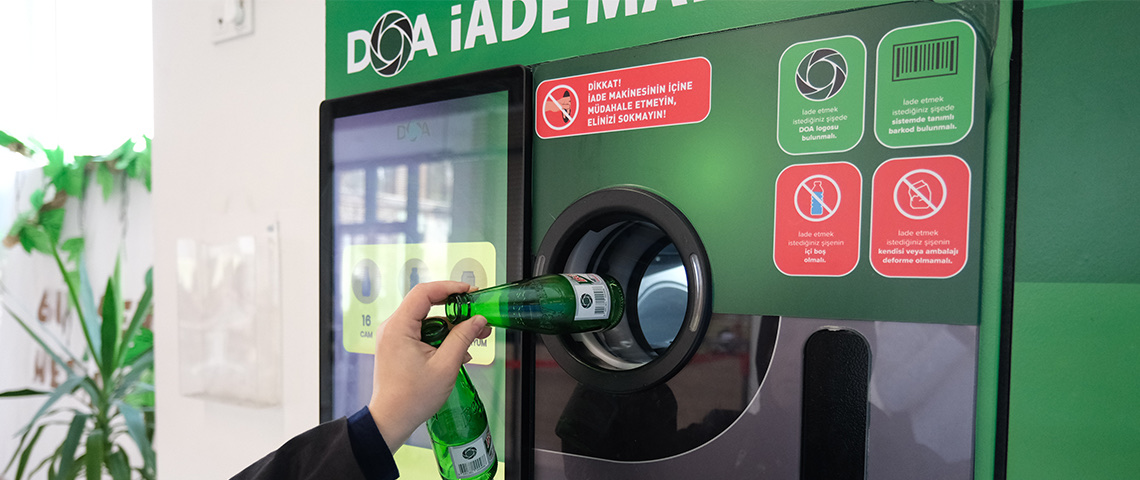
Türkiye's Deposit Return System (DOA) applies to eligible beverage containers carrying the official DOA logo.
After purchasing a participating product, consumers can return the empty container to designated collection points. Once the container is verified, the deposit amount is transferred to the user's digital wallet within the DOA system.
By encouraging consumers to return packaging instead of discarding it, the system aims to improve recycling performance, reduce packaging waste, and support more efficient resource management.
Small Actions Create Long-Term Environmental Impact
Returning a single bottle or beverage can may seem like a small action, but millions of individual choices can collectively create meaningful environmental impact.
Deposit Return Systems demonstrate how everyday habits can contribute to cleaner environments, more efficient resource use, and stronger circular economies. When consumers, businesses, and public institutions participate together, simple actions become part of a much larger environmental solution.
Conclusion
Deposit Return Systems are becoming an important component of sustainable waste management around the world. By encouraging the return of beverage packaging, they help reduce waste, improve recycling, conserve natural resources, and support the transition toward a circular economy.
While no single solution can solve the global waste challenge on its own, Deposit Return Systems show how practical, everyday actions can contribute to long-term environmental progress. Together with responsible production, sustainable consumption, and innovative environmental technologies, they represent another step toward a more resource-efficient future.
References
- Türkiye Environmental Agency. Deposit Return System (DOA).
- Republic of Türkiye. Ministry of Environment, Urbanization and Climate Change.
- UN Environment Programme (UNEP). unep.org.
- Ellen MacArthur Foundation. Circular Economy.
- OECD. Circular Economy.
- Reloop Platform. reloopplatform.org.
- European Commission. Packaging and Packaging Waste.
- OECD. Global Plastics Outlook.